Let me guess how you got here.
Maybe you’ve started over more times than you can count. New plan, new planner, new Monday. You went all in — meal prepped like you were feeding a small army, worked out four days in a row, color-coded something. And then life did what life does. You missed a day. The day became a week. And you quietly filed the whole plan under “maybe after the holidays.”
Or maybe you’re the opposite. You don’t have a follow-through problem — you have a full calendar and the receipts to prove it. You get things done. Everybody knows you get things done. It’s just that everything you’re getting done lives in two or three corners of your life, and the rest — the sleep, the friendships, the walk you keep meaning to take, the thing you used to do just because it made you happy — is running on fumes. You’re crushing it and quietly wondering why it doesn’t feel like it.
Here’s the part that gets me. Either way, you decided that meant something about you. That you’re lazy. Or that you’re just someone who can’t have it all. That everyone else got the balance gene and you got skipped. So before you read one more sentence of this book, I need you to hear this:
You don’t have a discipline problem. You don’t have a motivation problem. You don’t have a “too much on my plate” problem.
You have a dose problem.
Some of you have been dumping the whole shaker on one dish. Some of you have been pouring everything you’ve got into three areas and sprinkling nothing on the rest.
Either way, the fix is the same. This book is about sprinkling into every part of your life — your mind, your body, your rest, your joy, your home, your money, your people, your heart — instead of drowning a few of them and starving the rest.
Keep reading, free
Read the rest of the Introduction
Tell Charissa who's reading, and the rest opens right here.
No newsletters, ever. Your name and email stay with Charissa.
The 2 A.M. That Started All Of This
This book did not come from a vision board or a master plan or a perfectly timed fresh start. It came the way everything good in my life shows up — a little at a time, usually while I was in the middle of something else.
Specifically, it came at 2 a.m.
You know that kind of waking up. Not the groggy kind. The lights-on kind. One second you’re out cold, the next you’re wide awake, and there’s a phrase sitting in your head like it’s been waiting all day for you to be quiet enough to hear it.
Sprinkle it.
That was it. That was the message. Write a book called Sprinkle It. Here are five chapters. Go.
I lay there in the dark, staring at the ceiling, and I want you to understand something: I have never wanted to write a book. Not once. Not as a kid, not as a “someday” thing, not even as one of those goals you write down and never look at again. So my first thought was not “what a beautiful idea.” My first thought was, “Who is this for, and why are you telling me?”
But I am not a 2 a.m. idea person. I’m a sleep-through-the-night person. So when one showed up anyway, I figured I’d better pay attention. I grabbed my phone and started typing before it got away.
I didn’t write chapters. I wrote down the themes, all five of them, and a few stories that popped into my head, in rough, sleep-blurry notes: the mindset piece. The food piece. The movement piece. The rest piece. The joy piece.
The next morning I read those notes back like they’d been written by somebody else. Where did this come from?
And then it hit me. This wasn’t a new idea at all. This was how I had gotten through my entire adult life — the overloaded years and the empty ones. I’d been doing it forever.
I just had never given it a name.
What “Sprinkle It” Actually Means
To sprinkle it is to take one small, intentional action — honestly, sometimes an embarrassingly small action — today. In the actual life you have. With whatever energy showed up this morning, even if the answer is almost none.
Not when things calm down. Not after you buy the right equipment. Not when you feel like it. Not Monday.
Today.
It looks like this:
One push-up instead of no push-ups. One glass of water before the coffee. Ten squats on a bathroom break. Five minutes outside instead of zero. One vegetable added to dinner — not a dietary overhaul, a vegetable. Texting one friend instead of hosting the dinner party you’ve been planning since 2019.
And if you’re already running at full speed, it looks like this:
Ten minutes of nothing between meetings instead of zero. One night a week where dinner is whatever’s easiest and nobody apologizes. Leaving the last email until morning. Sitting on the porch for the length of one song. One thing on the list that’s for you, and not at the bottom.
I know what you’re thinking. That’s it? One push-up? I have goals, thank you very much.
Or, from the other side of the room: Ten minutes? I don’t have ten minutes.
I hear you. Both of you. But stay with me, because small is not the compromise here. Small is the strategy.
Small actions compound. They stack. And every single one sends a signal — to your habits, your energy, your sense of who you are — that says: I am someone who shows up. Repeat that signal enough times and it stops being something you do.
It becomes who you are.
And for those of you who are already doing plenty, small is how you put something back into the areas you’ve been starving without dropping the ones you’ve been feeding. You don’t have to do less. You have to do a little, in more places.
The Part I Didn’t Plan On Telling You
If you saw yourself in that second picture, the full calendar running on fumes, this is where I tell you: I was you.
For most of my adult life, I never had the luxury of falling apart.
I was the woman who had to keep everything together.
Kids to get out the door. Meals to make. A home to run. Work to do. A whole life balanced on two shoulders. There was no space to disappear for six months and “find myself.” Things had to get done, so they got done.
What I didn’t understand back then was how I was making it all work. I wasn’t living some laminated-planner life. I was not waking up at 4 a.m. to meditate on a mountain. I was squeezing life into the cracks of life — five minutes here, ten minutes there, a phone call in the car, a list scribbled at the kitchen counter while something boiled over.
I didn’t have a name for it. It wasn’t a “system.” It was survival. And then everything changed.
When I became single, I suddenly had something I hadn’t had in decades: space. Time. Freedom. Fewer built-in demands. I was sure this was it — the moment I’d finally become the hyper-productive version of myself I’d been promising for years.
Instead? I started spinning.
Without the deadlines and the external pressure, my rhythm disappeared. The same ten-minute task I used to knock out while something boiled over now stretched across a whole afternoon, and I’d get to dinnertime with nothing to show for the day but a vague feeling that I should have done more. Things I used to power through started feeling heavy. And I want to be really clear about this, because I know how it sounds: I didn’t get lazy. I’d stopped doing the one thing that had been working all along, and I never even knew I’d been doing it.
The small pockets. The tiny moves. The do-it-now-before-you-forget moments. That wasn’t a coping mechanism I got to retire once life gave me room to breathe.
That was the method. It had been the method all along.
And here’s what I see now that I couldn’t see then: I was sprinkling it constantly, but only ever into the same four places.
Everything else — the rest, the friendships, the joy, me — got nothing. The method was right. The distribution was off.
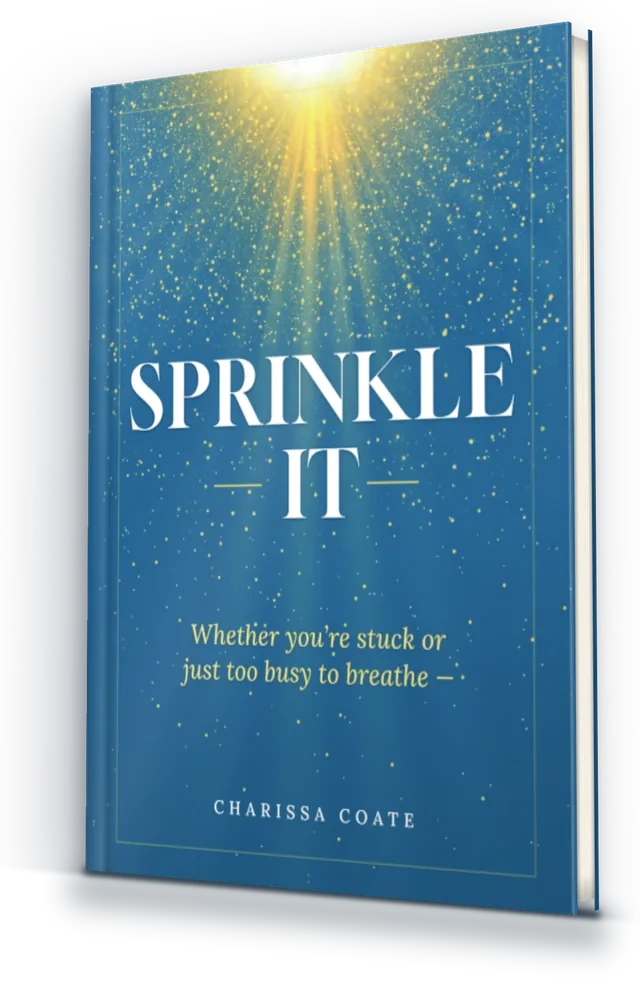
I call it Sprinkle It. And it’s what this whole book is about.
Why This Works When The Big Plans Don’t
Your brain does not like big plans. It doesn’t hate them. It just quietly refuses to show up for them.
The moment you announce you’re overhauling everything — your eating, your exercise, your schedule, your entire personality — your brain does the math on the distance between here and there, decides the numbers are terrible, and files the plan under “aspirational but implausible.” Then it suggests you sit down.
Why do you think the gym is packed in January and a ghost town by March? Millions of perfectly capable people don’t lose their discipline every spring. Their brains just did the math.
The same math kills the other kind of plan, too — the one where you’ll finally rest, reconnect, and reclaim your evenings once you’ve restructured your entire week. Your brain looks at “restructure my entire week” and decides next month sounds better. It always will.
But watch what happens when you shrink the ask. I’m going to drink one glass of water right now. I’m going to sit on the porch for one song. Your brain shrugs. “Fine. Sure.” You do it. And something small but real happens: you feel like a person who does things — or, if you already do plenty of things, like a person who has a life.
That feeling is fuel. It makes the next small thing slightly easier.
And the one after that. And the one after that.
This is not complicated. It is not a proprietary seven-step system with a trademark. It is simply how humans actually change: incrementally, imperfectly, one tiny decision at a time, repeated until it becomes who you are.
How To Use This Book
Sprinkle It is organized into five parts, and it moves from the inside out: you first, then your world, then your people, then your heart and soul, and finally what it looks like to live it. You do not need to read them in order. If rest is the thing that’s on fire — or the thing you haven’t touched in months — go straight to Chapter 4. If it’s your eating, Chapter 2 is waiting for you. If your brain is the primary obstacle — and let’s be honest, it usually is — start at Chapter 1.
At the end of every chapter you’ll find a short set of exercises: specific, concrete, today-level actions. Not “reflect on your relationship with food.” Actual things. Things you can do before you put the book down.
And we start small.
That’s not the limitation of this book. That’s the whole magic trick.
Now — go get a glass of water. I’ll wait.
Look at that. Before Chapter 1 even starts, you’re already sprinkling it.

Excerpted from Sprinkle It by Charissa Coate. Copyright © 2026 by Charissa Coate. All rights reserved.